REVIEW · PORTLAND
Smartphone-Guided Walking Tour of Downtown Portland
Book on Viator →Operated by Wandering Tours · Bookable on Viator
Portland has a way of hiding stories in plain sight. This smartphone-guided walking tour turns big downtown landmarks into a simple route you can do at your own pace. You start near Pioneer Courthouse and end by the Willamette, with the help of prompts and short quizzes along the way.
I especially like the mix of well-known stops with Portland-specific details you might miss if you just wander. The quiz questions add momentum, and the route gives you a basic, usable overview of downtown history and architecture without feeling like homework.
One drawback to keep in mind: the information can feel a bit thin for a price that’s close to $30 per group, and you may find yourself walking a few blocks before the first main landmark.
In This Review
- Key things to know before you go
- Starting at 202 NW Davis St and finishing by the Willamette
- Pioneer Courthouse and Pioneer Courthouse Square: early Portland in two quick stops
- Columbia Sportswear and John Helmer Haberdasher: outdoorsmanship and Portland crafts
- Arlington Club: the power brokers story you can’t actually enter
- Shemanski Fountain and Arlene Schnitzer: civic generosity and theater drama
- Portlandia: public art you can’t miss
- Salmon Street Springs, Mill Ends Park, and Morrison Bridge: the river makes it all make sense
- Price and value: $27.50 per group up to 15 people
- Practical tips that will make the walk feel easier
- Who should book this smartphone-guided downtown Portland route?
- Should you book this tour? My call
- FAQ
- Is this tour self-guided on a smartphone?
- How long does the walking tour take?
- How much does it cost and what group size is it for?
- Where do I start and where does it end?
- Is admission included at every stop?
- Is it available in English and does it have accessibility notes?
Key things to know before you go

- Smartphone-guided and private: only your group follows the route, so it stays calm and focused.
- About 11 short stops: most stops are around 4 to 5 minutes, so it moves.
- Early Portland through modern quirks: you’ll hit civic buildings, craft shops, fountains, theater, and public art.
- Trivia included: quiz moments help break up the walk and make the facts stick.
- Not everything is enterable: some places are view-and-learn, not ticket-and-tour.
- Rain-ready route: one clear tip from past walkers is to dress for rain, since Portland loves a quick drizzle.
Starting at 202 NW Davis St and finishing by the Willamette
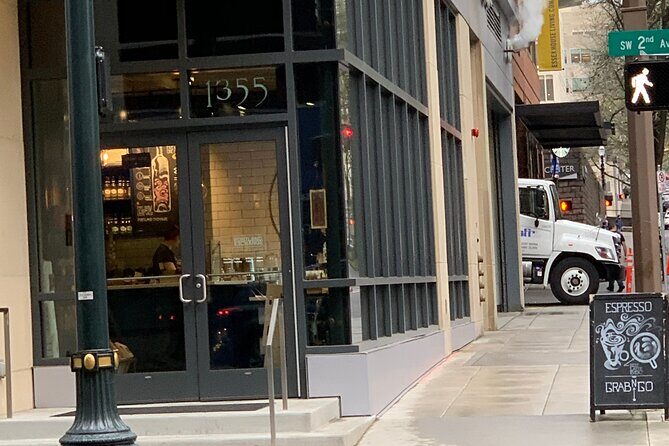
The tour meets at 202 NW Davis St, Portland, and it finishes at Bill Naito Legacy Fountain on SW Naito Pkwy, near the Portland Saturday Market by the river. That end point is handy because it drops you in the right area to keep exploring on foot after the tour.
Timing is also pretty realistic. Expect about 1 hour 10 minutes to 1 hour 30 minutes, depending on how long you pause for photos and reading. Past experiences with this kind of self-guided format usually feel easiest when you’re not trying to do a lot of extra stops of your own in between.
This is offered in English, and it’s set up as a private tour/activity, limited to your group (up to 15 people). You also get confirmation at booking, and free cancellation is available up to 24 hours in advance for a full refund.
More Walking Tours & Audio Guides in Portland

Pioneer Courthouse and Pioneer Courthouse Square: early Portland in two quick stops
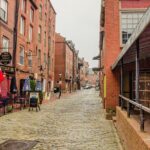
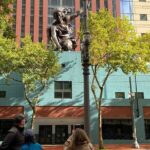
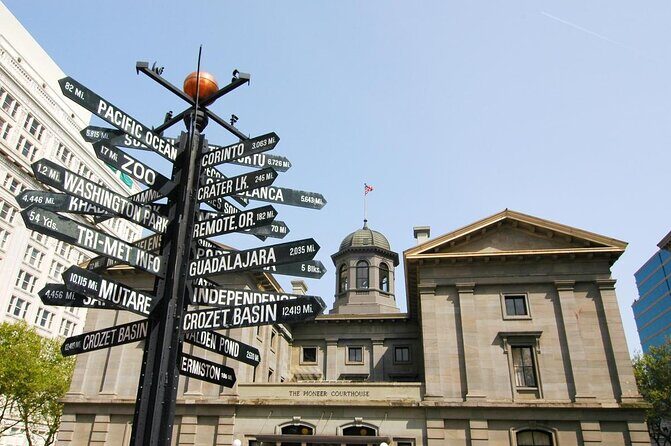
You kick things off at Pioneer Courthouse. The framing here matters: you’re placed in the heart of downtown and guided to notice how this landmark connects to a time when Oregon was still not fully shaped by colonization, and Portland was more of a fledgling outpost of the United States. Even if you’ve visited downtown before, this can re-orient how you think about the city center.
Next is Pioneer Courthouse Square, right across the street. This is one of those Portland moments where the story feels almost too specific to be real: the square exists in part because of a pair of boots. That kind of detail is exactly why smartphone guides work so well for me—you end up looking at a space differently.
What you’ll like here: these two stops are compact and visually strong, so they’re good even if you’re short on time or traveling with someone who gets restless.
Possible drawback: if you already know a lot about Portland civic history, the early story may feel like a warm-up rather than a deep dive.
Columbia Sportswear and John Helmer Haberdasher: outdoorsmanship and Portland crafts
From civic landmarks, you shift into Portland’s culture of making and selling things. At Columbia Sportswear, the tour focuses on outdoorsmanship in Portland and an immigrant success story tied to entrepreneurship and innovation. It’s a reminder that Portland identity isn’t only parks and rivers. It’s also businesses built on local passion.
Then you land at John Helmer Haberdasher. This stop leans hard into the arts and crafts movement—the idea that Portland has supported local makers for a long time. You’ll connect that movement to the shop’s creative community through examples like hats and other crafts such as ceramics or photography.
What you’ll like here: you get two different angles on creativity—one tied to performance outdoors, the other tied to handmade culture. It’s a nice change from the usual downtown sightseeing pattern of just churches and monuments.
Possible drawback: the stops are brief (about 5 minutes each). If you’re the type who loves lingering inside shops or reading every plaque, you may want to set yourself up to do extra exploring after the tour ends.
Arlington Club: the power brokers story you can’t actually enter
Next comes Arlington Club. Here’s the key expectation: you cannot enter this organization. The tour’s approach is more about storytelling than access—explaining how power brokers in Portland have operated, historically and culturally, through spaces like this.
Even without entry, it can be compelling because it puts a name to the “who runs things” question that hangs in any major city. You’re not being sold a fantasy museum tour; you’re being guided to look at the place as part of Portland’s social structure.
What you’ll like here: it adds intrigue without requiring tickets.
Possible drawback: if you were hoping for an inside visit, you’ll feel that gap. This is a view-and-learn stop, not an experience where you settle in for a guided interior.
Shemanski Fountain and Arlene Schnitzer: civic generosity and theater drama
Stop six is Rebecca at the Well Shemanski Fountain. This is one of the calmer moments on the route. The guide frames Shemanski as one of those civic contributors who helped form early Portland, and it highlights the fountain as a gift to the city—located in a shady, restful spot that breaks up the walk through downtown bustle.
After that, you move toward Arlene Schnitzer Concert Hall. This stop leans into a darker, more dramatic mood: robberies, intrigue, and ghosts—plus Wild West stories and impressive renovations that restored the theater. Whether you believe in the supernatural or not, the point is that historic theaters often carry layered local myths.
What you’ll like here: the contrast. A shady fountain pause, then a story-heavy theater stop, gives your legs and brain a reset.
Possible drawback: the tour notes admission is not included for this stop, so you’re mostly there to learn and observe rather than go inside for a show or formal tour.
More Portland Oregon City Tours





Portlandia: public art you can’t miss
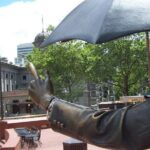
Then comes Portlandia, a three-story sculpture that also ties into the city’s pop-culture reputation. The tour makes clear that this is not the TV show, even though the show’s name came from the sculpture. You’ll also learn how the style has been controversial, and how the piece is visually compared to the Statue of Liberty in scale and impact.
I like this stop because it’s one of the easiest to “feel” in real life. It’s hard to read a description and truly understand the scale, but when you’re standing close, the idea clicks.
What you’ll like here: it’s photo-friendly and very Portland, in the best way.
Possible drawback: admission isn’t included, so expect the experience to be mostly outside viewing and guided context rather than ticketed access.
Salmon Street Springs, Mill Ends Park, and Morrison Bridge: the river makes it all make sense
Now you get to Portland’s core theme: water. Salmon Street Springs honors the Willamette River, framed as the river that helped create Portland. It also connects the city to seafaring traditions, which gives the fountain a bit more meaning than a typical streetscape stop.
After that, you reach Mill Ends Park, described as the smallest park in the world, with Guinness approval. That tiny scale comes with a big story: you’ll learn how the park came to be and what the future holds. It’s a very Portland lesson—serious history can show up in a very small footprint.
Finally, you close with Morrison Bridge. Portland has plenty of nicknames, but this one is practical: the City of Bridges. The tour connects the bridge to how the river links both sides of the city and links the city to the river and out toward the sea. It also points out that Portland has pioneered new technologies to help cities function, and it ties those ideas to the bridge itself.
What you’ll like here: this trio helps you connect the dots between Portland’s founding, its present-day design, and why downtown looks the way it does near the water.
Possible drawback: because each stop is timed tightly, you might not get as much time at the fountain or park as you’d like if you’re the type who enjoys sitting and watching.
Price and value: $27.50 per group up to 15 people
At $27.50 per group (up to 15 people), the price doesn’t work like a per-person ticket. It’s more like you’re paying for a guided route plus smartphone content, then splitting the cost if you’re traveling with friends or family.
That matters for value. If you’re going solo or as a couple, it can feel pricier than a free brochure—especially since one recurring criticism is that some of the facts may feel like they could be found elsewhere. If you’re walking with a small group, the cost per person drops fast, and the quiz-and-route structure becomes more worth it.
Duration is also part of the value equation: 1h10 to 1h30 is long enough to feel like a real outing, but short enough that you won’t drain your whole day. I think that’s a smart match for visitors who want “downtown orientation” rather than a full, ticket-heavy day.
Practical tips that will make the walk feel easier
Wear shoes you trust. Downtown Portland walking adds up, and the route is timed by stops. Also, plan for weather. One clear takeaway from past walkers is to dress for rain, since drizzle can turn comfortable pavement into slippery pavement fast.
Use your phone, but don’t let it turn into a distraction contest. The tour is smartphone-guided, and the quizzes add fun, but your best results come when you pause, look up, and then read. Portland rewards eye contact: street art, architecture, and little story details are everywhere.
Lastly, build a little buffer into your plans. The tour runs about 11 stops, and you’ll likely want to do a few photos on the way in and out of each one. If your next activity is right after, give yourself a few extra minutes so you don’t feel rushed.
Who should book this smartphone-guided downtown Portland route?
This tour is a good fit if you want a clean, low-pressure way to learn downtown Portland without committing to a long, ticket-heavy day. It’s also useful if you like structured walking—places are spaced so you don’t wander aimlessly, but it’s still flexible enough to stop and look.
It’s especially attractive for groups of up to 15 people because the price is per group, not per person. If you’re traveling with family or friends, it can also be a fun way to compare answers during the quiz moments.
If you’re the type who wants deep, layered interpretation at every stop, you might find the pace and factual depth to be only decent for the cost. The tour is designed for quick orientation, not a slow, museum-style experience.
Should you book this tour? My call
I’d book it if you want a fun, organized downtown walk with Portland-specific stops, short trivia prompts, and a practical overview that helps you understand why certain landmarks matter. The route is well paced for a first visit, and the mix of civic sites, craft culture, public art, and river-focused landmarks keeps it from feeling repetitive.
I’d skip it (or at least lower your expectations) if you’re hoping for a lot of detailed storytelling at each location or inside access to places like Arlington Club or the concert hall. At this price, you’re really buying the convenience of the route and the quiz format, not a full academic tour of downtown Portland.
FAQ
Is this tour self-guided on a smartphone?
Yes. It is a smartphone-guided walking tour, and it’s designed as a private activity for your group to follow.
How long does the walking tour take?
Plan for about 1 hour 10 minutes to 1 hour 30 minutes.
How much does it cost and what group size is it for?
It costs $27.50 per group, up to 15 people.
Where do I start and where does it end?
You start at 202 NW Davis St, Portland, OR 97204, USA, and you end near Bill Naito Legacy Fountain at 2 SW Naito Pkwy, Portland, OR 97204, USA by the Portland Saturday Market area.
Is admission included at every stop?
Some stops are listed with free admission, while others are marked as admission not included. Also, Arlington Club is a stop where you cannot enter.
Is it available in English and does it have accessibility notes?
The tour is offered in English. Service animals are allowed, it’s near public transportation, and most travelers can participate.
You Might Also Enjoy

More Tour Reviews in Portland
- The Real Portland Tour: City and 3 Lighthouses Historical Tour with a Real Local
★ 5.0 · 1,448 reviews